

Why You Should Go And What To Expect At This Amazing Open-Air Museum In Big South Fork
Nestled in the heart of Big South Fork National River and Recreation Area, Blue Heron, Kentucky stands as a testament to the region’s rich coal mining heritage.
This abandoned coal mining town, now transformed into a fascinating outdoor museum, offers visitors a unique glimpse into the lives and stories of the people who once called Blue Heron Mining Camp home.
I love visiting Big South Fork National River and Recreation Area for the camping and hiking in this awesome park (it’s part of the national park system) but also because it has wonderful historical sites like Blue Heron.
Growing up in East Tennessee, I have been to my fair share of coal mining museums, and I think Blue Heron Kentucky is one of the best, especially for kids.
I think it is a super interesting and unique museum, and it is one the kids enjoyed as well. Plus, the added benefits of being free and always open – what more could you want?
I’ll share why you should visit Blue Heron Mining Community, what to expect, as well as fun activities nearby.
P.S. See my 11 Things To Do In Big South Fork for more ideas.

Heads Up: This post may contain affiliate links, meaning we may get a commission if you decide to make a purchase through our links, at no additional cost to you. We don’t accept money in exchange for specific recommendations. Read more about our philosophy.
Why Go To Blue Heron, Kentucky?
To Hear Stories From The People Who Actually Lived There
Blue Heron, Kentucky is a type of open-air museum, which are my favorite to visit because the learning is much more interactive than in a regular museum.
In this case, the former coal mine camp has been recreated with steel frames echoing individual buildings such as the general store, the laundry, or a typical house.
You walk a path between each structure as they would have been found in the original town, really recreating a sense of place.
Each structure has a large informational sign with descriptions and photographs showing its purpose at the camp and the people who used it.
The most interesting part though, and one I think makes Blue Heron unique among these types of museums, is that you can press a button to hear the actual people who lived there telling stories about each place.
Again, it really gives a more complete sense of what Blue Heron was like and what it meant to the people who lived there. It almost makes like a type of living history museum, where the past is brought to life by recreating it.

Entrance to Mine 18 aka Blue Heron Mine, one of the stops on the self-guided tour of Blue Heron Kentucky. 
You can see how the miners work when you walk up to the Mine 18. Press a button to hear stories from the miners themselves as you look at the recreated scene.


History Of Blue Heron Kentucky, AKA Mine 18
In 1899, a Michigan timber baron named Justus Stearns bought up 30,000 acres of land on the Cumberland Plateau and the Stearns Coal & Lumber Company was born in 1902.
The nearby town of Stearns, Kentucky was their hub and the Kentucky & Tennessee Railroad was built to bring coal there from all of their mines, which eventually numbered 18. Blue Heron Mining Community was built to support Mine 18, which was opened in 1937.
The railroad didn’t just bring coal, it also was used to bring supplies and workers back and forth from these coal camps, which were very much “company towns.” Stearns Coal & Lumber Company not only owned the mine and the railroad, it owned the houses, the general store, and even ran the school.
These camps were meant to be somewhat transitory in nature – as mines ran out of coal and new mines were developed, the buildings could be disassembled and transported by train to the new camp.
So the buildings weren’t typically made out of lasting materials with deep foundations. Meaning when the coal mines began closing in the 1950s, the abandoned camps quickly deteriorated.
Mine #18 was closed in December of 1962 and the buildings of the Blue Heron, Kentucky were either transported to another camp or left to rot. In 1976, Stearns sold the last of its mines to Blue Diamond Coal Co. which itself stopped operating in 1987.
Blue Heron Interpretive Center was opened in 1989 with the re-created “ghost structures” illustrating the town once here.
For more information, I found the following websites to be helpful before our visit:
- https://www.nps.gov/biso/learn/historyculture/blueheron.htm
- https://www.nps.gov/biso/planyourvisit/upload/blueheronguide.pdf
- https://bsfsry.com/our-story/
- http://npshistory.com/publications/biso/arch-engr-res.pdf
What To Expect On The Self-Guided Tour Of Blue Heron Mining Community
When you first drive up to Blue Heron (or hike in, that’s an option too), the first thing you notice is the humongous Tipple and the Railroad Bridge across the river.
They dominate the landscape of Blue Heron, much like they would have done back when they were built. (The Tipple is where the coal cars brought all the coal to be sorted in case you didn’t immediately know what that meant – I didn’t :).
Even though the kids will want to check out the Tipple first because it is so large, or walk across the bridge (because who doesn’t), try your best to steer them to the old train depot to start your exploration.
There are lots of exhibits here telling the history of Blue Heron, plus a neat model of the community back in its heyday.
Pick up a brochure to start walking on the self- guided trail around Blue Heron or you can start without one too. The sign in front of each building on the loop tells you what you need to know.
The loop begins across from the train depot along the river at the old general store. From there, you go in a clockwise direction around the loop.


Don’t forget to push the audio button on each sign to hear the stories from the actual people who lived here. This was the best part about Blue Heron I thought, even if sometimes the accents were a little hard to decipher.
After one of the sidio recordings one fo the kids said “They must be real mountain people.” And these kids grew up in Blount County right by the Smokies if that tells you anything.
The trail is paved and easy to walk although it climbs up the hill to a former mine entrance and then back down again to the river.
The kids loved the old mine entrance and were surprised by how short the ceiling height was. It must have been so claustrophobic to work in there.
The kids were blown away to find out from the audio recording that the miners were only paid 60 cents per TON of coal they dug, especially after I explained how much a ton was.
Another highlight for the kids was the bathhouse and the idea that the miners were so dirty that they had to shower before they could come home or their wives wouldn’t let them in the house.
One of the stories we heard mentioned how life at home was a constant battle against coal dust. I can only imagine.
And last but not least, you MUST walk across the bridge and enjoy the views – even if you are a scaredy- cat like me who wouldn’t get near the sides.
It really is terrific to see the Big South Fork River and the gorge from this vantage point. Plus, you can access some great hiking trails on the other side.
* Unfortunately the Tipple Bridge was closed in 2023 for structural repairs and has not reopened yet as of Dec 2025. Let’s hope the work gets done soon because the I think the bridge is such a big part of what makes Blue Heron special.

The old tipple and bridge at Blue Heron Interpretive Center 
You can walk across the old coal train bridge to reach hiking trails on the other side of the river from Blue Heron. 
Looking across the old coal train bridge at Blue Heron 
The view down the river from the bridge at Blue Heron Kentucky


Ticket Prices
None. It is free to visit the Blue Heron Mining Community, another reason to love it!
Opening Hours
The outdoor exhibits are always open. The Interpretive Center (the large modern building with rangers, bathrooms, water, and WiFi) is open April 1- Oct 31, 930 am – 430 pm, Wed – Sun.
Where Is Blue Heron Mining Community?
Located 20 minutes from Stearns, Kentucky, it is at the end of Blue Heron Road, off of Route 742. You can find it on Google Maps as Blue Heron Mining Community.
Other Activities In Blue Heron, Kentucky
Hiking
The 6.5 mile Blue Heron Loop Trail is one of the best in Big South Fork in my opinion. The trail climbs up to the bluffs overlooking Blue Heron and nearby Devils Jump rapid, then circles back around to the mining community along the river.
Or you can do it the reverse way and walk along the river first, then climb up to the bluffs – your choice. The official trailhead is up on the bluffs near the Devils Jump Overlook but you can also get on the trail from the parking lots at Blue Heron.
Across the bridge, you’ll find the Kentucky Trail, which runs through the Kentucky side of the park. A ranger once recommended to me that I should hike it from here to Catawba Overlook and to Dick Gap Overlook (a roughly 5 mile RT from the bridge) but the one time I tried it, the weather turned iffy and I had to turn back.
There were some interesting bits of mining history along the trail though – rusted gears and train car parts. It remains on my list to do.
For more information, including maps and pictures, check out 12 Of Our Favorite Big South Fork Hiking Trails.
Water Activities
There is a boat launch at Blue Heron and the stretch from here to Yamacraw is a popular one for paddlers as it is beginner-friendly (no Class IV rapids like Devils Jump which is just upstream :).
If you don’t have your own boat, look at rentals or guided trips from Sheltowee Trace Adventure Resort.
There is a horse crossing here and a trail on the other side of the river but be careful of wading if the water levels are high. The current can be deceptively fast.
Scenic Train Ride
If you want to continue your mining history exploration, venture over to Stearns, Kentucky to hop on the Big South Fork Scenic Railway.
It will take you on a 30 minute train ride out to Barthell Coal Camp where Mines #1 and #2 produced the first coal in 1903 for Stearns Coal & Lumber Company.
The railway operates on the same track that the original Kentucky & Tennessee Railroad operated by the coal company ran on. There is a 2 hour layover at Barthell Coal Camp, which has had its buildings restored to historically accurate states (guided tours of the coal camp cost extra).
The Big South Fork Scenic Railway used to have a train that came to Blue Heron but I was told due to track issues, it does not any longer.
If you are looking for even more ideas of what to do in the area, check 11 Things To Do In Big South Fork. We have hikes, scenic overlooks, horseback riding, etc – basically a complete guide to Big South Fork.

The Blue Heron Mining Camp is right on the Big South Fork river and is a popular place for kayakers and canoers to put in. 
Fall scenes like this are why Southern Living called Big South Fork Scenic Railway one of the 14 Best Fall Train Rides In The South 
Leftover mine equipment along the trails across the bridge from Blue Heron 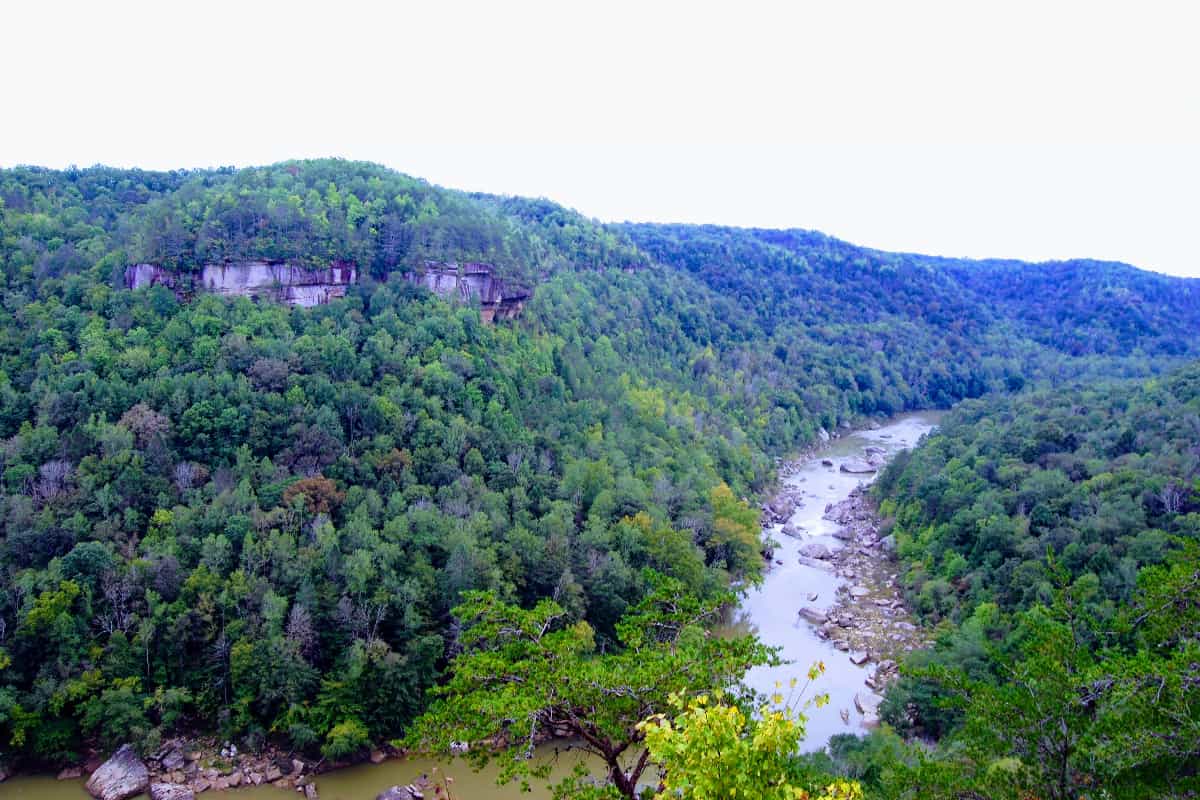
Devils Jump overlook from the Blue Heron Loop Trail


Where To Stay Near Blue Heron, Kentucky
Charit Creek Lodge
There aren’t any good hotels near Big South Fork National River and Recreation Area so your choices are limited to camping or vacation rentals. The one exception being the hike-in Charit Creek Lodge on the west side of the park in Tennessee.
I love, love, love Charit Creek so if a short hike to historic cabins and delicious food sounds good to you, read A Review Of Charit Creek Lodge | Find Out Why It Is An Unforgettable Family Adventure. It will tell you everything to expect and how the reservations work.
Camping
The closest campground to Blue Heron is the aptly named Blue Heron Campground, one of several front-country campgrounds in Big South Fork.
I don’t like it as well as Bandy Creek Campground, but if you are going to spend most of your time on the Kentucky side of the park, it will be much more convenient.
For more information about Blue Heron and the other campgrounds in Big South Fork, read Camping in Big South Fork. I talk about each of the 5 campgrounds in Big South Fork, the pros and cons of each.
Vacation Rentals
The area around Big South Fork has lots of cabins for rent and many for a good deal cheaper than you would find at more well known national parks, i.e. the Smokies. It is a great place to find a family weekend getaway.
See a list of vacation rentals near Big South Fork here (VRBO).
Read The Best Big South Fork Cabins | Find your Perfect Vacation Rental Retreat to find a list of my favorite cabins in the area based on a combination of price point, location, and amenities.
Final Thoughts
I hope you find some time to get in a visit to Blue Heron, Kentucky on your Big South Fork adventure. I think it is a super interesting and unique museum and it is one the kids enjoyed as well. Plus, the added benefits of being free and always open – what more could you want?!
Happy Trails – Amanda


